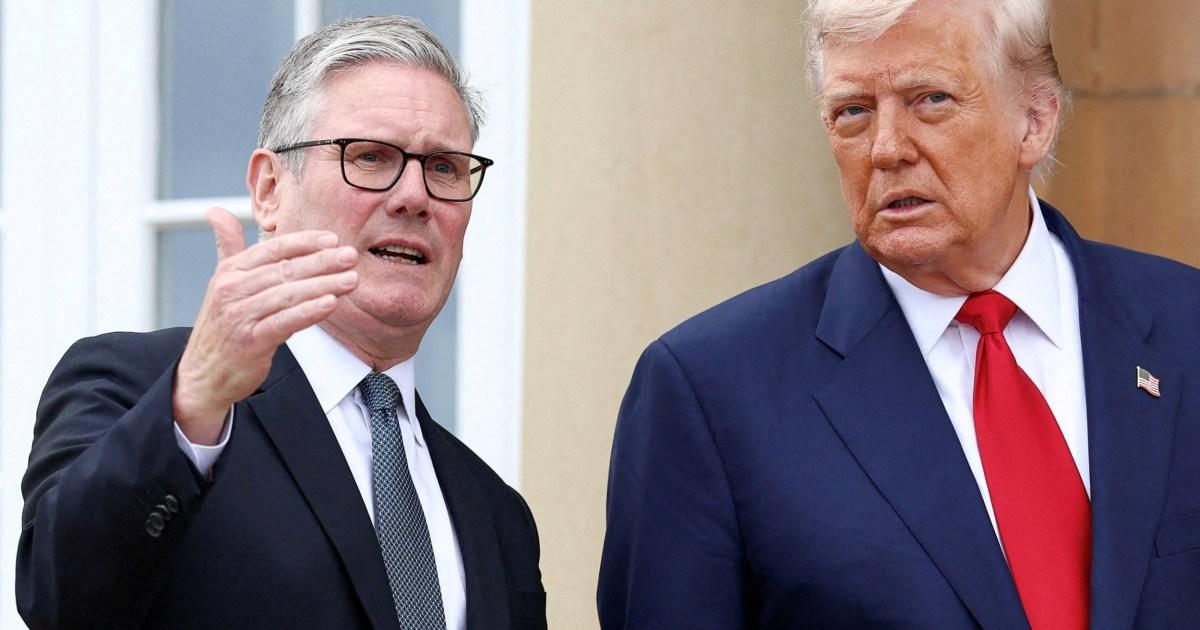
It’s the geopolitical ‘bromance’ which everyone loves to gossip about.
The UK-US alliance has been described as having nothing other than a ‘special relationship’ for close to 80 years.
It is under the spotlight once again with Donald Trump making an unprecedented second state visit to the UK this week.
As with every other encounter between PM and President, it will be closely watched for any signs of a split as the pair discuss important international issues such as the wars in Ukraine and the Middle East.

It is not just political, either. The Royal Family have played a crucial role befriending US leaders.
The King and Queen will do the same this time around as they greet Trump at Windsor Castle and take him on a carriage ride around the grounds.
Their meeting comes as just over a third (36%) of Britons said they have faith in the US-UK alliance, a new Ipsos poll revealed.
But what is the ‘special relationship’ and what does it mean for the UK? Metro takes a look at this geopolitical friendship.
When did the UK’s relationship with the US begin?
Things didn’t always start off so friendly between the two countries.
The US once launched a bloody war of independence back in 1776 to detach from the British Empire, followed by another brutal conflict decades later.
But things began to change in the 20th century when the pair teamed up to fight two world wars together.

The word ‘special’ wasn’t thrown into the mix until when a certain Winston Churchill was warning about the looming Cold War.
In his famous 1946 speech in Missouri he declared an ‘Iron Curtain’ had fallen across Europe and said the special relationship was crucial to saving the West.
What benefits does the ‘special relationship’ have?
The close alliance is not just about personal friendships and fancy banquets.
The two countries have developed a deep network of cooperation on intelligence, defence and security.
This has included joint participation in wars in Korea in the 1950s and against Iraq and Afghanistan.
The UK also buys their nuclear weapons technology from the US to build its own submarines and warheads.

It is not all one way traffic, however. The UK’s formidable intelligence services are also extremely valuable across the pond.
The two countries belong to the intelligence sharing partnership known ‘Five Eyes’ alongside Australia, New Zealand and Canada.
They are leading participants in the NATO security alliance and both are permanent members of the United Nations Security Council.
British PMs and US presidents also meet at G7 and G20 summits of leading global economies.
This makes sense because both nations are among the world’s largest economies.
The US is also the UK’s single largest trading partner, generating hundreds of billions of pounds worth of trade.
Which UK and US leaders enjoyed the closest relationship?

While much of the ‘special relationship’ happens behind the scenes, the bond between prime ministers and presidents often symbolise how well the two allies are working together.
Things never looked better than when Margaret Thatcher and Ronald Reagan were in charge.
The two were conservative political soulmates and elected just one year apart, in 1979 and 1980 respectively.
The pair became ‘dear friends’, with the British PM even calling her counterpart ‘the second most important man in my life’ after her husband.
Thatcher and Reagan were often snapped dancing together at glamourous balls or riding golf caddies together.
The friends also forged a crucial partnership in tackling international issues and bringing an end to the Cold War.
Thatcher was one of the first world leaders to persuade Reagan to trust Soviet leader Mikhail Gorbachev.

While the bond between their success waned in the following decade, it was picked up again by Tony Blair and US President George Bush.
The two were unlikely friends from two different sides of the political aisle, but came steadfast friends after the US was rocked by 9/11.
Blair was a strong ally of Bush’s push to go to war in Iraq, which saw the PM labelled a ‘poodle’ of the US leader.