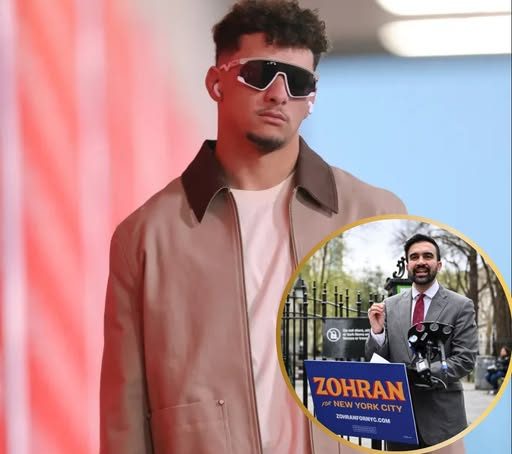
New York’s mayoral race has taken countless twists, but none have shaken the conversation quite like Patrick Mahomes stepping unexpectedly into the spotlight—not to endorse a candidate, but to warn an entire city. Known for his poise under pressure and his calm leadership on the field, Mahomes rarely inserts himself into political debates. That’s why his comments about Zohran Mamdani instantly went viral.
What began as a routine interview about football, family, and the future of the Chiefs suddenly shifted tone when Mahomes was asked about New York’s rising political figure. His expression changed. His voice dropped. And the superstar quarterback—usually composed, confident, and upbeat—gave an answer that left millions stunned.
He said he could not support Zohran Mamdani.
He said he had serious concerns.
And then he revealed the part that electrified the internet: a troubling reason he wasn’t willing to explain publicly.
The silence after his statement became louder than any criticism he could have voiced. And within minutes, social media exploded with theories, anxieties, and debates.
Zohran Mamdani, one of the most polarizing political figures to emerge in years, has built a massive following by pushing bold, progressive ideas. His supporters see him as a courageous visionary; his critics paint him as too radical, too unyielding, too unpredictable. His rapid rise has already divided communities, sparked protests, and ignited passionate discussions about New York’s future.
But Patrick Mahomes entering the conversation—and refusing to back Mamdani—pushed the controversy into a completely new dimension.
Mahomes didn’t attack Mamdani’s policies. He didn’t criticize his background, his identity, or his supporters. Instead, he focused on something deeper—something personal. And the weight in his voice suggested he wasn’t speaking lightly.
Sources close to Mahomes describe him as someone who takes responsibility seriously. He doesn’t make statements without thinking through the consequences, and he avoids political conflict unless he believes it truly matters. That’s why fans felt the impact immediately. This wasn’t a celebrity chasing attention. This wasn’t a social media stunt. It was a man who felt compelled to speak, even if he didn’t want to explain everything he knew.
Observers noted how carefully he spoke. He didn’t sensationalize. He didn’t dramatize. But he also didn’t downplay the seriousness of his concern. That balance—urgent but controlled—sparked even more speculation.
What exactly did he learn about Mamdani?
Was it political? Personal? Ethical?
Was it something said behind closed doors?
Or something Mahomes witnessed firsthand?
The lack of answers only amplified the tension.
Meanwhile, Mamdani’s supporters rushed to defend him, dismissing Mahomes’ comments as vague and unhelpful. His critics, however, seized the moment, pointing to the quarterback’s warning as validation of their fears. Neutral observers simply wanted clarity.
But the heart of the moment wasn’t about taking sides—it was about the emotional intensity beneath Mahomes’ words. His discomfort was visible. His hesitation was real. And in an era when public figures often speak with scripts, filters, and rehearsed statements, his raw sincerity felt like a shockwave.
Mamdani’s campaign has not responded directly. The candidate continues to draw huge crowds, maintaining his momentum despite the growing controversy. But there’s no denying that Mahomes’ refusal to support him has added a new dimension to the race—one that blends politics, trust, and human intuition.
New York is a city that thrives on certainty and despises ambiguity. But Mahomes left the city not with answers, but with a haunting question: What did he hear that made him speak up?
In a political climate already loaded with tension, his silence has become its own kind of message—a hint that something beneath the surface may be worth examining more closely.
Mahomes didn’t ask New Yorkers to take sides. He didn’t demand loyalty or offer instructions. He simply urged caution. And sometimes, in a city built on noise, the quietest warnings echo the loudest.
As New York’s mayoral race intensifies, one thing is clear: Patrick Mahomes’ unexpected message has added a new emotional layer to an already heated competition. And for millions watching, his words—careful, troubled, unshakably sincere—may be the turning point they cannot ignore.