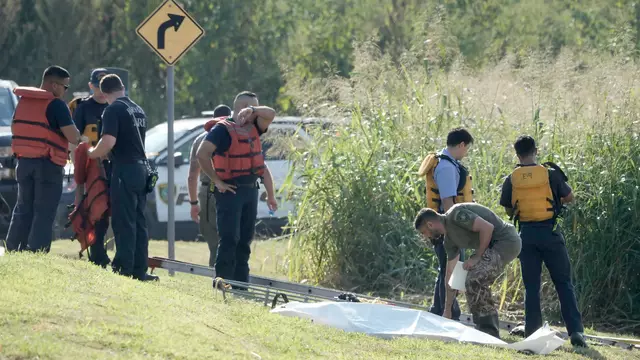
Fears that a mass murderer is still at large in Houston, Texas have returned this week, after a 30th body was pulled from the city’s bayous.
Three sets of remains were discovered by police floating within the city’s waterways within the last seven days alone, months after officers were forced to deny that the drownings were the work of a serial killer.
Six bodies were previously found in September – men and women with ages ranging from their 20s to their 60s – between the Buffalo Bayou, Hunting Bayou, Brays Bayou, and White Oak Bayou.
Some of their deaths were put down to accidental drowning, a number supposedly involving some kind of intoxication. In the case of 20-year-old university student Jade McKissic, however, her cause of death remains ‘undetermined’ to this day, given that no trauma was detected by coroners.
In light of these five, the city’s mayor John Whitmire was forced to shut down speculation that a possibly dangerous individual was on the loose.
“Enough of misinformation [and] wild speculation by either social media, elected officials, candidates, the media,” Whitmire declared in a press conference back in September.
“We do not have any evidence that there is a serial killer loose in Houston, Texas.”
Despite agreeing during the same speech that the death toll is ‘alarming’, the mayor argued that factors like homelessness, alcohol use, and mental health issues could also be to blame for the sudden surge in cases.
“I grew up in Houston,” Whitmire continued. “Unfortunately, drowning in our bayous is not a new phenomenon.”
Noe Diaz, the city’s chief of police, also agreed at the time, insisting: “There is no evidence, and I repeat no evidence, to suggest that any of these incidents are connected.”
Harris County District Attorney, Sean Teare, has also been forced to address the most recent reports, however, after the Houston Chronicle put this year’s total number of bodies to at least 34.
“There is nothing, nothing, and I want to be crystal clear, to indicate that there is someone operating here as a serial killer,” he told KPRC. “There are many reasons for these deaths. None of them are a serial killer.”
Going on, Teare insisted of the drownings: “It’s kind of a little-known fact, but when you get into the bayous, it is very difficult to get out.
“When you combine that with someone that is high on some substance, someone that is intoxicated somehow, it makes it even more difficult.”
He did confess, however, that there have been times when he team have recovered ‘bodies that were placed in the bayou criminally’, ‘no question’.
“But that is not something that is a regular occurrence,” Teare concluded, though.
Despite this assertion, retired NYPD sergeant and criminal justice professor Joseph Giacalone believes ‘something is afoot’.
Advising investigating officers to tread carefully when ruling out a multiple-murderer, he previously told Fox News it’s ‘unlikely’ that the numbers are part of a ‘coincidence’.
“A careful inspection of each case is warranted,” Giacalone continued. “Including the 48 hours prior to the discovery of their disappearance.”