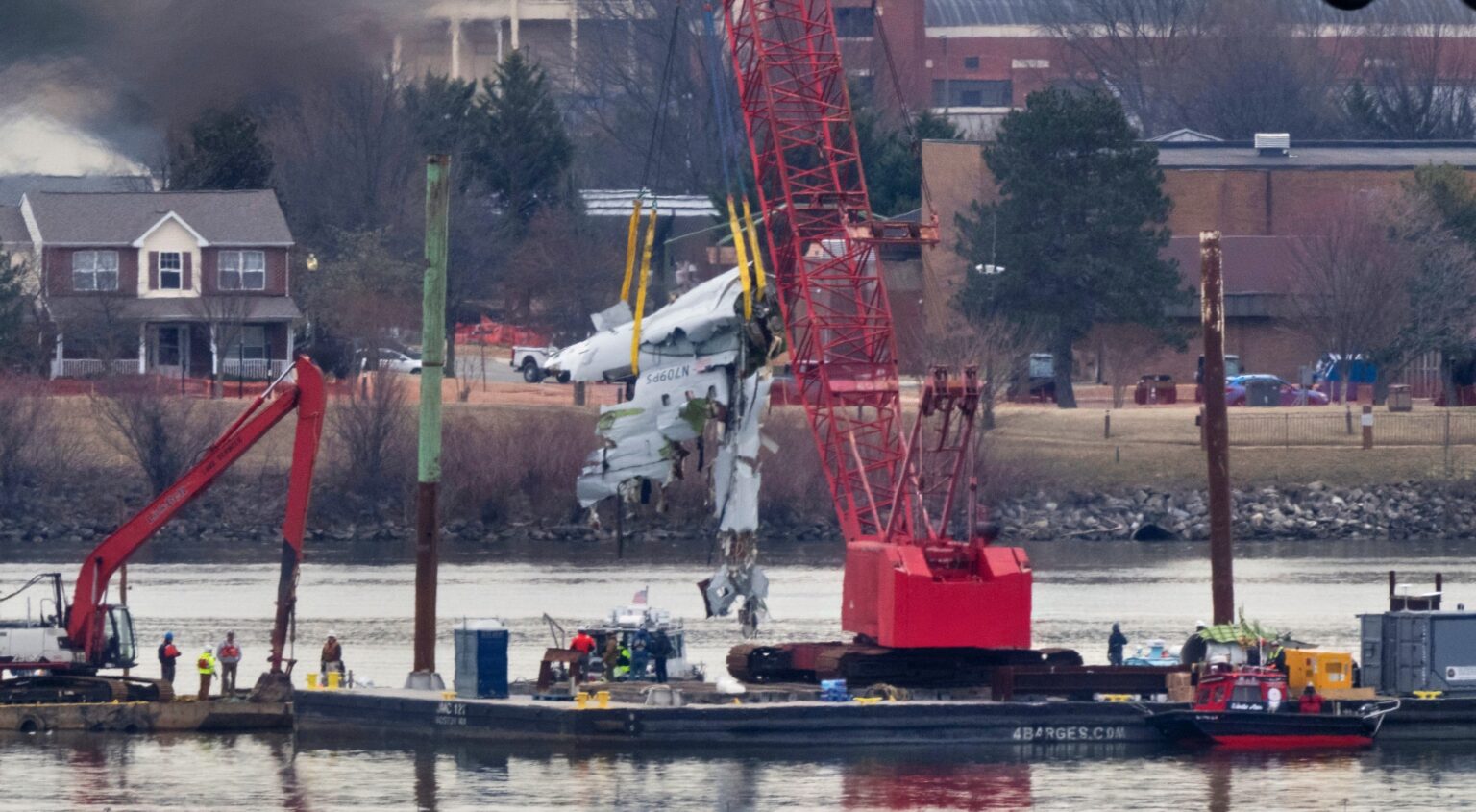
The National Transportation Safety Board (NTSB) has disclosed several key findings from its investigation into the DCA plane crash that killed 67 people late last month.
The incident is still under investigation following a military Black Hawk helicopter colliding with an American Airlines commercial flight before both aircraft went down into the Potomac River.
Per WKYC.com, the probe revealed that the three soldiers in the chopper were likely wearing night vision goggles that, if removed, would have required them to discuss operating without them. There was no evidence pointing to such a discussion taking place.
The NTSB said investigators are still trying to determine why the pilot’s and instructor’s altitude readings were different and that faulty altimeter readings may have led to the Black Hawk flying much higher than it should have.
It notes that “Just 20 seconds before impact, air traffic control asked the Black Hawk crew if they had the CRJ in sight. The response remains under review.”
Around 17 seconds before the crash, air traffic control told the helicopter to fly behind the airplane while it was preparing to land, but the pilots may have missed “a critical part of that message” because they were trying to speak to ATC at the same time and stepped on the audio.
“CVR data from the Black Hawk indicated that the portion of the transmission that stated ‘pass behind the’ may not have been received by the Black Hawk crew,” NTSB Chairman Jennifer Homendy said. “Transmission was stepped on by a .8 second mic key from the Black Hawk. The Black Hawk was keying the mic to communicate with ATC.”
American Airlines Pilots Tried To Avoid DCA Plane Crash, But Their Attempts Came Too Late
Per NTSB data, the pilots on the American Airlines flight made attempts to avoid the Black Hawk.
“One second before impact the CRJ began to increase its pitch. Reaching about 9 degrees nose up at the time of collision,” Homendy said. “FDR data show the CRJ elevators were deflected near their maximum nose up travel.”
The NTSB is still analyzing data from cockpit voice recorders and flight data recorders to determine exactly what happened but insists it’s too early to conclude on probable cause.
Communication protocols, differences in information on altitude, and pilot decision-making will be thoroughly investigated as part of the investigation.