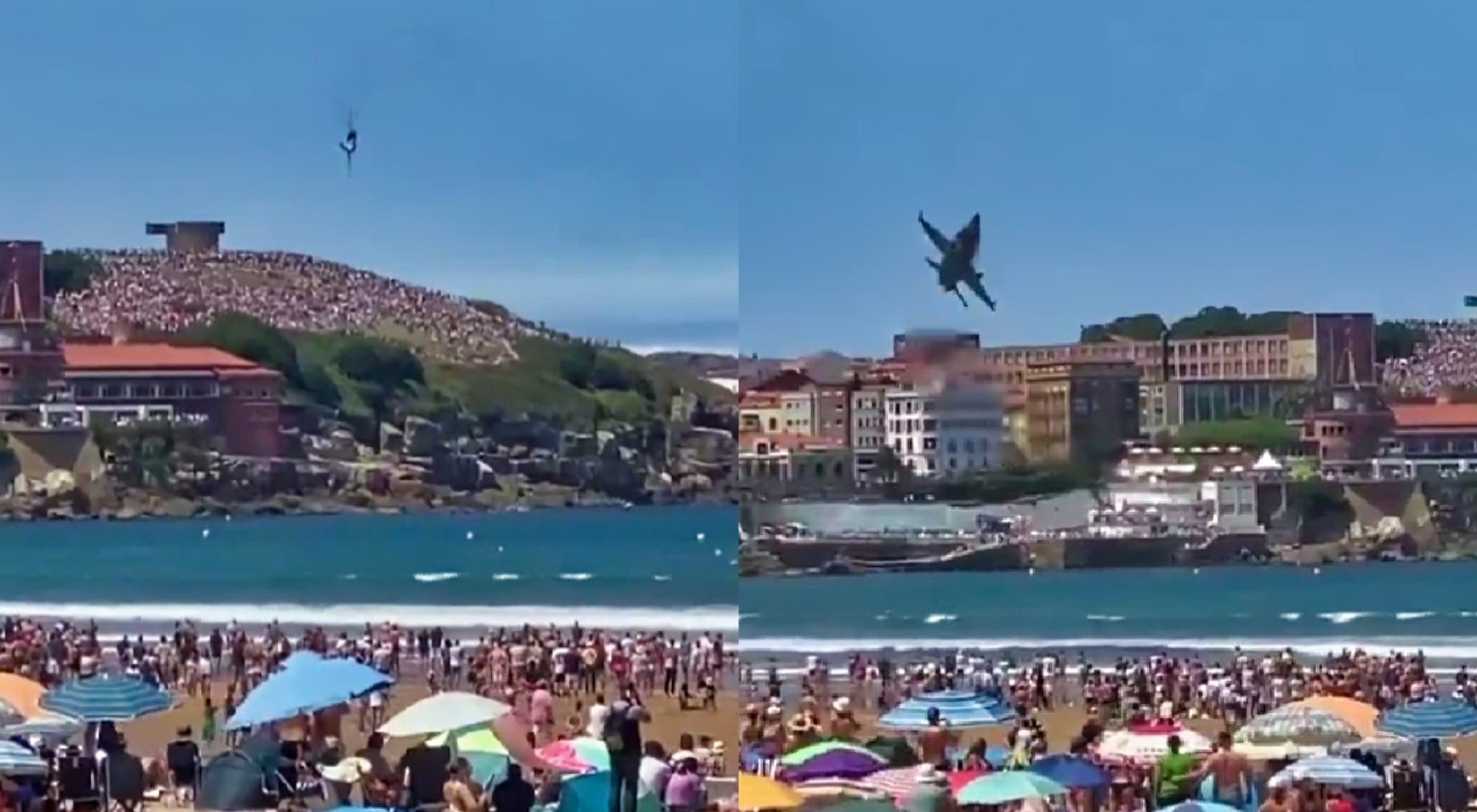
It happened on Sunday at the Gijon Air Festival, held above the buzzing San Lorenzo Bay. Thousands had gathered under the summer sun, phones in hand, kids on shoulders, eyes fixed on the sky. That’s when an EF-18 Hornet, part of the Spanish Air Force’s aerial display, dropped dangerously low after a sudden roll. For a moment, it looked like disaster was seconds away.
Then the jet pulled up. Fast. Black smoke trailed behind as it soared back into control. People screamed. Some ducked. Most froze, cameras still rolling. The footage spread like wildfire online, with many questioning what just happened.
Fighter Jet Pilot Avoids Disaster In A Split Second

The Spanish Air Force stepped in quickly to explain. In a post on X (formerly Twitter), officials said the pilot spotted a flock of birds directly in his flight path. With no time to waste, he pulled an evasive right roll to avoid a deadly bird strike.
“Many of you have been asking us, so in this thread, we’ll tell you what happened during the Gijon air festival,” the Air Force wrote. “As you have seen, one of our F-18 fighters performed an evasive manoeuvre upon detecting a flock of birds in its path.”
They called it standard protocol, part of the training every Spanish fighter pilot undergoes. “Our aviators are trained to react in milliseconds,” the post continued. “In this case, the pilot acted with exemplary speed and professionalism, avoiding a possible collision without compromising the exhibition.”
A collision at that altitude, especially near a packed beach, could have ended in tragedy. But it didn’t. Thanks to razor-sharp instincts and training, what could have been a national disaster became a near-miss story with a sigh of relief.
Interestingly, just last month, a Spanish EF2000 had its canopy shattered by a bird strike during another airshow. It’s a reminder that even the sleekest machines in the sky are vulnerable, and that behind each one is a human making life-or-death decisions in real time.