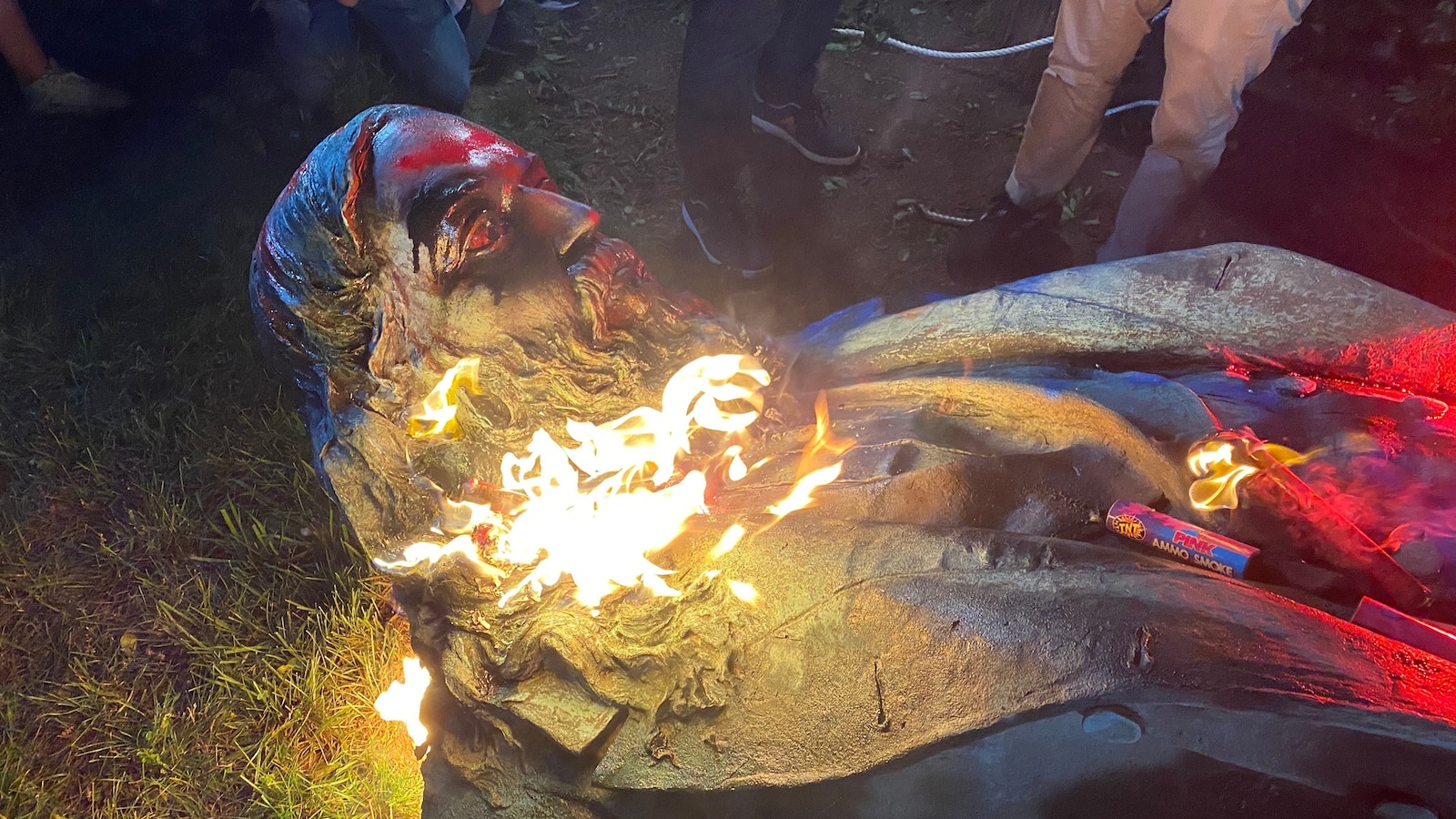
The statue of Albert Pike, who served as a brigadier general in the Confederate Army during the Civil War, was the only outdoor statue in the nation’s capital honoring a Confederate figure, according to the National Park Service, though it was officially erected to “honor Albert Pike’s influential role in the Masons.”
The statue was located in the Judiciary Square neighborhood, about half a mile from the U.S. Capitol.
“The restoration aligns with federal responsibilities under historic preservation law as well as recent executive orders to beautify the nation’s capital and re-instate pre-existing statues,” the National Park Service said.
As protests against racism swept the nation in the summer of 2020, following the May 25 death of George Floyd at the hands of Minneapolis police officers, protesters called for the removal of numerous statues and other memorials across the country honoring Confederate figures. Protestors burned and toppled the Pike statue on June 19, 2020.

At the time, President Donald Trump criticized the protesters who brought down the statue of Pike, calling for their arrest in a post on the app formerly known as Twitter.
“These people should be immediately arrested. A disgrace to our Country!” Trump posted.
Asked on Tuesday by ABC News about the Trump administration’s plans to reinstall the statue, a spokesperson for Bowser declined to comment.
Following the National Park Service’s announcement, Washington, D.C., Democratic Congresswoman Eleanor Holmes Norton’s office announced that she would “reintroduce her bill to permanently remove the statue and authorize the Secretary of the Interior to donate it to a museum or a similar entity.”
“A statue honoring a racist and a traitor has no place on the streets of D.C.,” Holmes said in the statement, in part.
Symbols of the Confederacy around the U.S. had faced some opposition for decades, but the movement to remove or replace them gained momentum in the wake of Floyd’s killing.
Several statues of Confederate figures and slave owners were swiftly removed in June 2020 in states including Alabama, Virginia, Indiana and Florida. The Army also issued a statement saying that top military leaders were “open to a bi-partisan discussion” about renaming of military bases that were named after Confederate leaders.
But Trump, who was serving his first term as president at the time, voiced his opposition to the notion, saying on June 10, 2020, that his administration “will not even consider” renaming military bases.

Under the Biden administration, the names of more than half a dozen Army bases named after Confederate figures were changed by 2023, but Trump announced while speaking to Army soldiers at Fort Bragg in North Carolina on June 10 that his administration would restore the base names.
The latter directed Vice President J.D. Vance and Interior Department Secretary Doug Burgum to restore federal parks, monuments, memorials and statues “that have been improperly removed or changed in the last five years to perpetuate a false revision of history or improperly minimize or disparage certain historical figures or events.”
The National Park Service said that the Pike statue was authorized by Congress in 1898 and dedicated in 1901 to honor “Pike’s leadership in Freemasonry, including his 32 years as Sovereign Grand Commander of the Ancient Rite of Scottish Freemasonry.”
It has been undergoing restoration by the National Park Service’s Historic Preservation Training Center and is expected to be on public display again by October, according to the National Park Service.