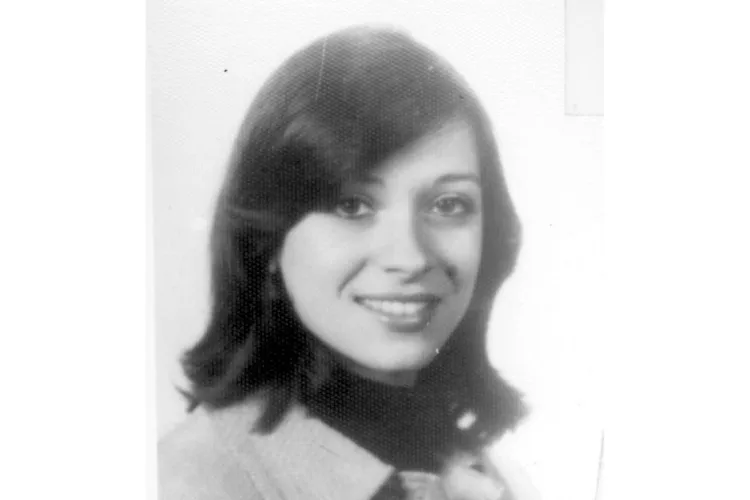
Considered “subversives” by the military dictatorship during Argentina’s Dirty War, she and her partner, José Manuel Pérez Rojo, had finally thought they were safe until they were each separately abducted by at least 20 men, who converged on José’s elderly aunt’s house in a neighborhood north of Buenos Aires later that evening.
The couple was trapped in vehicles and could only watch as their daughter, Mariana, was given to a relative in a basket.
As José begged his family to take care of his little girl, Patricia gave one final yell, shouting, “I’m pregnant! They’re taking me to—”, before her mouth was covered by a guard. They were never seen again.
The harrowing scene is recounted in A Flower Traveled in My Blood by Haley Cohen Gilliland, which was published by Avid Reader Press last month.
Patricia’s disappearance, and the fate of her unborn child, prompted her desperate mother, Rosa Tarlovsky de Roisinblit, to go on a decadeslong search; first for her daughter and son-in-law, then, as horrifying details of their fates became clearer, for the unborn grandchild she hoped still lived.
The story of Rosa, who will turn 106 in August, and other grandmothers like her, known as the Abuelas de Plaza de Mayo, is the focus of Gilliland’s debut work of nonfiction, which is the result of four years of investigative reporting and hundreds of hours of interviews.
Of the estimated 500 grandchildren stolen between 1976 and 1983, so far, the grandmothers have found 140 — the latest of whom they discovered just last month.
:max_bytes(150000):strip_icc():focal(749x0:751x2):format(webp)/stolen-grandchildren-7-071525-36997f572bd94d3680e8463a3ffebccf.jpg) “The worst thing that could ever happen to them had happened,” Gilliland tells PEOPLE of the grandmothers’ resilience. “In a way, that was freeing because they felt they had nothing else to lose. The worst next thing would be giving up.”
“The worst thing that could ever happen to them had happened,” Gilliland tells PEOPLE of the grandmothers’ resilience. “In a way, that was freeing because they felt they had nothing else to lose. The worst next thing would be giving up.”After decades of political turmoil, one of Argentina’s darkest periods began when a military junta led by Lieut. Gen. Jorge Rafael Videla unseated Isabel Perón in 1976 and launched a campaign of terror to get rid of perceived political opponents from the left, according to Britannica.
Patricia and José were part of the Montoneros, a leftist group that supported President Perón, before it disbanded.
An estimated 10,000 to 30,000 people, including pregnant women forced to give up their babies, were killed during the Dirty War. They became known as desaparecidos — the “disappeared.”
In A Flower Traveled in My Blood, Gilliland reveals the ways the grandmothers sacrificed everything — even their lives — to bring the truth of the killings to light, helping to topple the dictatorship and bring about revolutionary developments in genetic testing as they sought to reunite with stolen family members.
“The level of brutality, the disappearances, the death flights — that was shocking to Argentines across the board, and I think nobody could have predicted that,” says Gilliland of the regime’s state-sanctioned killings.
It wasn’t until February 1982 that Rosa learned that 25-year-old Patricia gave birth to a baby boy, whom she named Rodolfo Fernando, in captivity.
Initially, Patricia had been kept blindfolded and tied to a chair in the same house where José was tortured. As her due date approached, she was brought to the infamous detention center Escuela de Mecánica de la Armada (Navy School of Mechanics), known as ESMA, where prisoners were brutalized.
Later, the young woman’s family would piece together other details of her last days, including a rare statement from an air force officer who said that Patricia may have been “thrown into the sea” after giving birth to Rodolfo.
While José and Patricia were “disappeared,” the family was unable to confirm if they’d been thrown into the Rio de la Plata like so many others.
The existence of death flights had been previously documented, but in 1995, a former lieutenant commander made international headlines when he recounted how he helped throw naked and drugged political prisoners into the South Atlantic, according to the Los Angeles Times.
Gilliland says it was Patricia’s strength and her mother’s spirit that prompted her to highlight their family’s story.
“I felt particularly drawn to Rosa,” the author tells PEOPLE. “She has always been a maverick.”
:max_bytes(150000):strip_icc():focal(496x0:498x2):format(webp)/stolen-grandchildren-6-071525-4d166e74f6e94bc4ac90baf944fe1081.jpg)
Rosa, born to Jewish parents who escaped Europe during the pogroms, was an obstetrician, an untraditional path for women in Argentina during the 1960s and ‘70s. Rosa’s husband, Benjamín Roisinblit, died the same year their daughter was abducted.
Concerned about her firebrand daughter’s political movements, Rosa didn’t become an activist herself until her family was ripped from her.
Rosa joined up with the Abuelas de Plaza de Mayo and served as the organization’s treasurer for six years before working as vice president from 1989 to 2022.
“They really poured everything into her and made her the center of their universes,” Gilliland says of Rosa and Benjamín’s love for their only child. “And so I think her abduction and disappearance is an unimaginable blow.”
After years of searching, Rosa and her granddaughter — Mariana Eva Pérez, the child who was 15 months old when her parents and then unborn brother were taken — finally found the baby boy they’d hoped was out there.
“I saw him threaten her with a knife, hit her with a rifle butt, throw her on the floor and shout he would put a bullet in her,” Guillermo would later tell a courtroom of the way Francisco allegedly abused Teodora until their divorce, The Guardian previously reported. While Guillermo was not physically hurt by his father, the older man gave the boy the nickname “the Jew.”
Guillermo believed he was their biological son until Mariana broke from the Abuelas’ standard procedure and approached her brother at the fast food restaurant where he worked with a note and photo of her parents.
:max_bytes(150000):strip_icc():focal(478x0:480x2):format(webp)/stolen-grandchildren-3-071525-99592141a49d49718564f2a79058f6f5.jpg)
“I was very afraid,” Guillermo said of the life-changing moment, according to CBS News. “At that moment, I didn’t know who I was.”
After a DNA test confirmed that his biological parents weren’t the people who had raised him, the young man struggled with depression.
Never miss a story — sign up for PEOPLE’s free daily newsletter to stay up-to-date on the best of what PEOPLE has to offer, from celebrity news to compelling human interest stories.
“He talked about the complete loneliness and overwhelming alienation of that experience and how long it took him to grapple with that,” Gilliland says.
Beyond the death of his birth parents, Guillermo also had to come to terms with the fact that Francisco, the man who raised him, had worked at the same detention center where Patricia was held after she gave birth to him, according to The Guardian.
:max_bytes(150000):strip_icc():focal(749x0:751x2):format(webp)/stolen-grandchildren-5-071525-d08e5921d3c0457aac08ec97b6cb7d1e.jpg)
“He asked me to rest assured nothing bad happened to my mother while she was pregnant, though he couldn’t say the same about my father,” Guillermo told the paper of what Francisco said after he confronted him for the fourth time. “He said he took care of my mother, that he brought her food secretly on weekends. It was too much information for me.”
In 2016, Guillermo faced the man he’d called “father” in court, according to the outlet. Francisco was sentenced to life in prison, while Teodora was separately sentenced to three years in prison for Guillermo’s abduction, according to CBS News.
Francisco’s conviction was part of a wave of hundreds of military personnel and leaders who were prosecuted for human rights abuses.
There was no sunshine-filled, scenic ending for Rosa and her grandchildren. The truth of what Mariana and Guillermo’s parents experienced was too heavy. But Guillermo, who adopted the last name Pérez Roisinblit in honor of his birth parents, is now a human rights lawyer and works with his grandmother’s organization.
“I hope when a reader closes the back cover that, instead of feeling weighed down by that darkness, they’re inspired by how the Abuelas responded to it,” Gilliland says, “Their courage, resilience and the way that their love of family powered them forward.”
In her interview with The Guardian in 2016, Rosa, then 96, echoed that same sentiment when explaining why the Abuelas de Plaza de Mayo continued to search for their missing grandchildren.
“The strength comes from the love for your children,” she told the paper. “If I had stayed home crying for the disappearance of my daughter, I would have died long ago.”