Guillermo del Toro‘s “Frankenstein” has all of the elements that made Mary Shelley’s Gothic novel so chilling. There’s a hulking beast, whose body is assembled from the corpses of other men. There’s an obsessive inventor, who discovers a way to create life out of death, only to experience the violent consequences of his ambition. And there’s spooky catacombs, a mountaintop lab that’s straight out of a Hammer film, and buckets of blood and gore as Victor Frankenstein cobbles together his greatest creation. However, del Toro doesn’t see “Frankenstein,” which will debut at the Venice Film Festival on Aug. 30, as a horror movie.
“Ridiculous as it may sound, I see it as a biography of these characters,” he says. “In my movie, it is about the lineage of familial pain.”
Yes, this “Frankenstein” is a family drama as much as it is a creature feature. It examines how Victor Frankenstein (Oscar Isaac) was molded into a rash scientist by his oppressive father (Charles Dance), only to become an abusive parent to his “son,” the creature (Jacob Elordi), when he grows disappointed in what he’s made. Netflix is backing the $120 million epic and will release it in theaters for an exclusive three-week run on Oct. 17 before debuting it on streaming on Nov. 7. At a time when most genre movies are made on the cheap, Netflix is betting big that del Toro’s “Frankenstein” will be both a hit with subscribers and Oscar voters.
“Guillermo has thought about making this movie since he was a child,” says Bela Bajaria, Netflix’s chief content officer. “It’s what made him want to be a filmmaker in the first place. He wants to explore what it means to be a monster and a human being.”
Ahead of “Frankenstein’s” Venice debut, del Toro spoke to Variety about casting Isaac and Elordi, creating the look of the monster and finally bringing his passion project to life on screen.
Is “Frankenstein” really several decades in the making?
Absolutely. It took 30 years. It’s a movie I wanted to make before I even had a camera. There’s the DNA of “Frankenstein” on “Chronos,” on “Blade Two,” on “Hellboy.” And we were developing it at Universal before they passed. I pitched it everywhere. It’s been my Mount Everest to climb.
What is it about the story that so transfixed you?
When I saw the James Whale “Frankenstein” as a kid, I completely emptied my soul into the creature. I thought, “That’s me.” It was a religious and spiritual moment for me. As a kid, I was very Catholic, and I thought I was seeing a saint or a figure of myth that represented me. Even at that early age, I felt, “my God, this is so soothing for me to see the creature and his innocence.” He was an outsider. He didn’t fit into world. He was out of place in the same way that I felt as a kid.
It’s interesting that you call it “soothing.” You didn’t think of it as a scary movie?
No, I didn’t. It’s a story like Pinocchio, about a creature that is created by his father and thrown into the world, sort of into the deep end of the pool. He’s attempting to learn to swim by not drowning. “Frankenstein” is a song of the human experience. It’s the story of a father and a son. There’s so much of my own biography in the DNA of the novel and in the DNA of the movies.
In was ways is your biography wrapped up in the story of Frankenstein?
In every possible way. I relate to the story about how even if some injury in your family has been passed from generation to generation, you always have the opportunity to heal it. You can listen and learn from it. I also like the idea that beauty is not something that exists only in what people think is good or beautiful, but in the purity of existence. In the insect world, for instance, there are things that are beautiful that can also be savage and deadly from one moment to the next. That’s like this story.
I read somewhere that you thought about making this as a mini-series. Is that true?
No, I didn’t think about it as a miniseries. I thought about it as two movies. I originally wanted to make the same movie from two points of view and sort of contradict what you had seen in the first movie with the second one. But I decided it was much better to have a movie where there’s a hinge moment shortly after the creation, where the perspective shifts and you follow the creature in his travels after following Victor for the first part.
Why did you think of Oscar Isaac for the role of Victor Frankenstein?
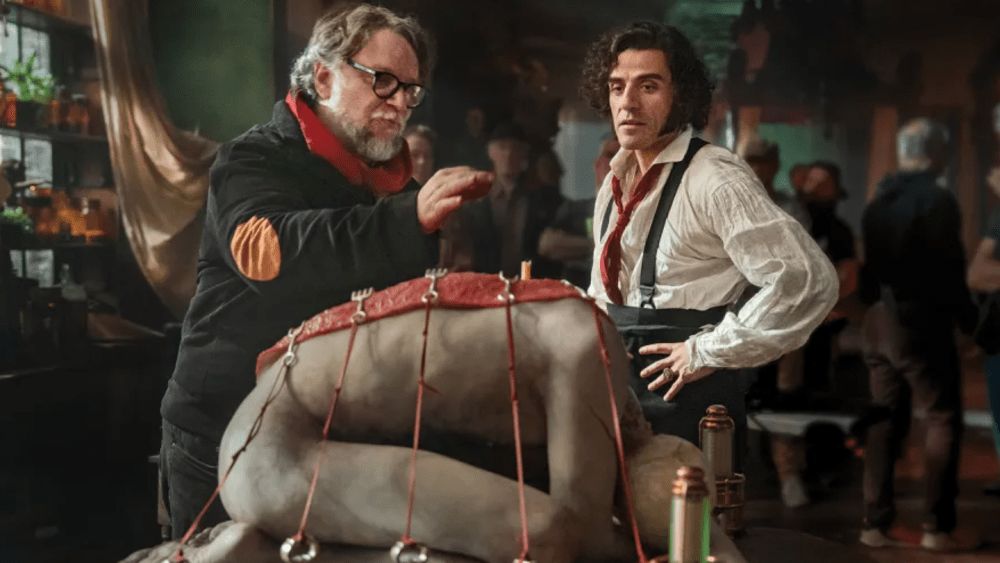
I wanted the movie to feel not as a thing of the past, but very modern and vibrant and alive with questions of today. Visually, I wanted a Victorian era that was full of color and mud and steam and dirt and cutting-edge science. I didn’t want to have a mad scientist. I wanted to make this sort of rock star genius, and Oscar has all the swagger and swarthy seductive power that Victor, in my mind, had. He’s like a Byronic rock star. And we did that with the wardrobe too; we patterned his wardrobe after London around the ’60s and ’70s. It’s lots of wide brim hats, bell bottom pants, heels on the shoes. If you saw him walking in Soho with Mick Jagger and Twiggy, you would say, “There goes another rock star.” Oscar also has a profound humanity. He can be seductive and he has a feline way of moving around that makes you understand how he could attract financial backers for his experiments.
Andrew Garfield was originally supposed to play the creature. After he dropped out, what made you think of Jacob Elordi?
I saw “Saltburn,” and I loved his innocence and openness. He plays the victim of a Tom Ripley-type of character, and I thought he played it with a lot of range. His character was also capable of being high class and cruel. Jacob’s eyes are so full of humanity. I cast him because of his eyes.
How did you decide on the look for the creature?
Ever since I started drawing the creature in the late ’70s and early ’80s, I knew I didn’t want symmetric scars and I didn’t want sutures or clamps. What I thought was very interesting was to make him like a jigsaw puzzle. I wanted him to look beautiful, like a newborn thing, because a lot of times, Frankenstein steps into the frame and he looks like an accident victim. But Victor is as much an artist as he is a surgeon, so the cuts had to make aesthetic sense. I always thought about him as made of alabaster. I never understood something about the other versions; Why does Victor use so many pieces from so many bodies? Why doesn’t he just resurrect a guy who had a heart attack? And the answer for me was, what if the bodies come from a battlefield? Then he needs to find a way to bring the corpses together in a harmonious way.
You shot this on massive sets and used a lot of practical effects instead of CGI. Why did you make that decision?
It’s extremely important for me to keep the reality of film craft alive. I want real sets. I don’t want digital. I don’t want AI. I don’t want simulation. I want old fashioned craftsmanship. I want people painting, building, hammering, plastering. I go in and paint props myself. I supervise the construction of the sets. There is an operatic beauty when you build everything by hand. You feel that you being swept along by the work of hundreds of people.
What did this movie cost to make, and how long did it take to shoot?
It took around 120 days and cost around $120 million. Whatever budget I get, I always say it should look like it cost double. “Shape of Water” was made for $19.3 million and I wanted it to look like a $50 million movie. “Pacific Rim,” which cost $190 million, I wanted it to look like $400 million. I think it is my fiduciary duty as a producer, and my artistic duty as a director, to have my ambitions always exceed the budget.
I wanted to ask you about the monster’s birth scene. It’s an iconic cultural and cinematic moment. How did you approach it?
Almost nobody shows the creation of the monster. Everybody shows thunder, and the monster is already put together. And I thought, if you are following a rock star, you want to shoot the concert. So instead of making it horrible that he is putting all these things together from bodies, I made it into a waltz. I made it into a joyous fun, sort of crazy concert. He’s running around the lab, putting this body together, grabbing this part and placing it together here or there. And where could we put the lab? Well, water towers were monumental edifices back in the day. And I thought, “Let’s put it there.” One of the secrets of designing a set is it needs to change. If you visit it more than four or five times, it needs to feel different every time. Otherwise, it gets boring. It becomes a cutaway to Seinfeld’s apartment. So in order to do that, I have to think of elements of light and set design, and I thought a big window is going to give you the cool light of the morning and then bask you in sunset later in the day. I got to think about four columns to carry the energy. They look green and copper, but when they are lit they become four lines of bright red.
You said that as a child, you related to the monster. But when I watched the movie there are all of these scenes of Victor drawing the creature. It made me think of you and how you design the monsters in your movies. Did you see some of yourself in Victor too?
Very much. To me, Victor is also a film director, and Harlander [his patron, who is played by Christoph Waltz] is the studio. He’s saying, “I’ll give you anything you want.” And then they say, “Well, except this one thing. You have all the freedom you need, but you can’t do that.” I don’t dislike any characters in my movies. I try to understand all of them. Everybody has faults. We live in a moment in which fallibility is almost a sin. But it’s important that Victor makes some cardinal mistakes, and the creature makes cardinal mistakes. At the end of the movie, if we did our job right, you understand why they did made those errors.
Did you see any parallels with AI or other technologies and the creation of the monster, who is this technological achievement that is ultimately uncontrollable?
Not for me. The usual discourse of “Frankenstein” has to do with science gone awry. But for me, it’s about the human spirit. It’s not a cautionary tale: It’s about forgiveness, understanding and the importance of listening to each other.
Because Netflix is making this movie, more people will stream it than see it on the big screen. Given that you’re painting on a vast canvas, does that bother you?
Well, we will get the biggest theatrical release that Netflix gives its films. I don’t know the exact number, but it’s three weeks exclusively and then it can stay in theaters longer. And Netflix is also going to release it on physical media, just like they did with [del Toro’s 2022 stop-motion film] “Pinocchio.” The theatrical experience is very important. I believe in it. But if the choice is between being be able to make the movie and have portions of the release be theatrical and portions be streaming or not make the movie, that’s an easy decision to make. For a filmmaker, you want to tell your stories.
You’ve struggled for much of your career to bring this story to the screen. What is it like to be on the verge of sharing it with the world?
I feel like the movie is very eloquent in what it is expressing. Whether people agree with its position about the world, I have no control over. One time a reporter asked Alfred Hitchcock: “Are you worried about posterity?” And Hitchcock said, “What has it done for me lately?” I feel like that about the future. What has the future done for me lately?