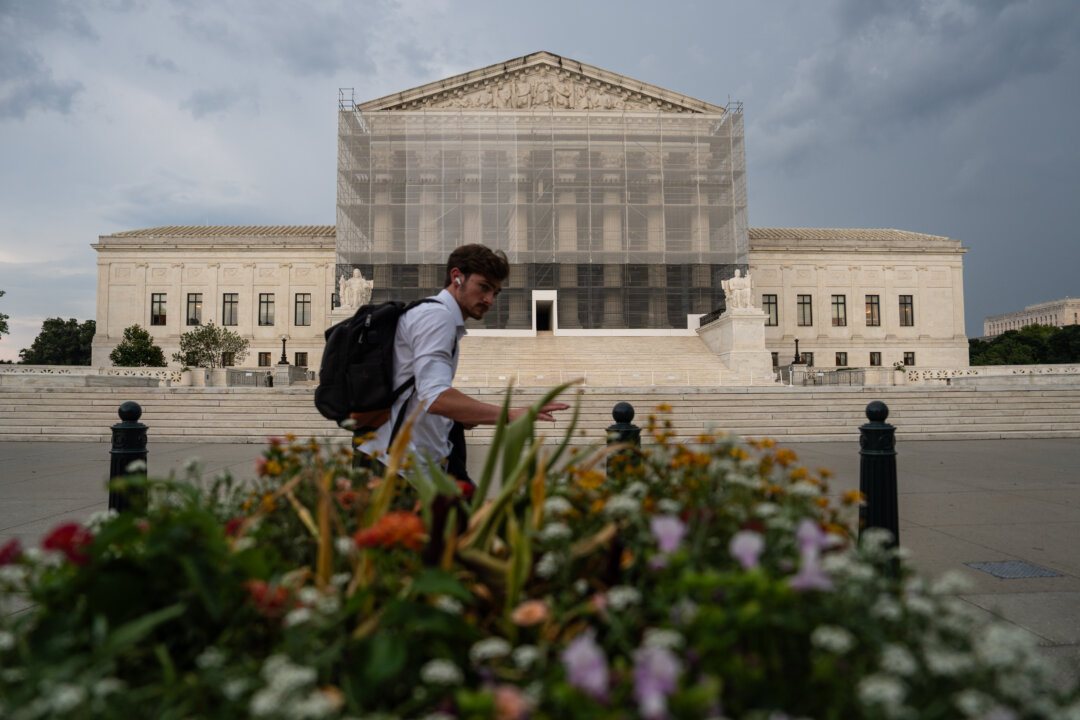
The Supreme Court issued a ruling on June 26 that could hinder Planned Parenthood’s ability to keep Medicaid dollars in states across the country. The case, known as Medina v. Planned Parenthood, focused on South Carolina’s attempt to defund the organization by claiming it wasn’t a qualified health provider.
A majority of the court, led by Justice Neil Gorsuch, said that a civil rights law—known as Section 1983—didn’t allow Medicaid recipients to sue because Planned Parenthood was disqualified in the state. According to the law firm that represented South Carolina, the majority’s decision liberated other states facing potential challenges to defunding efforts.
The 6–3 decision grappled with a provision of the Medicaid Act that gives recipients the right to work with the qualified provider of their choice. It also tackled the types of things protected under Section 1983, which generally allows private individuals to bring lawsuits over violations of their rights.
The decision came as the White House and Congressional Republicans moved to defund Planned Parenthood at the federal level.
According to Planned Parenthood, the Medicaid Act had created a right to choose one’s provider, and that right could be enforced through Section 1983.
Gorsuch and his conservative colleagues disagreed, stating that Medicaid should be viewed more as a form of government spending or benefits rather than rights. Moreover, Gorsuch said, Congress has to be very clear when it sets up a right in statutes, and that clarity wasn’t present in the disputed portion of the Medicaid Act.
Justice Ketanji Brown Jackson dissented with her two liberal colleagues, Justices Sonia Sotomayor and Elena Kagan. That opinion argued that Congress had used rights-creating language in setting up that provision of the Medicaid Act.
Jackson pointed to how Congress titled that section of the Act. It read, “Free Choice By Individuals Eligible For Medical Assistance,” which Jackson said “indisputably invokes language classically associated with establishing rights.”
Her dissent also warned that the court’s decision would “strip” Medicaid recipients across the country “of a deeply personal freedom.” Meanwhile, Justice Clarence Thomas said in a concurrence that courts had extended Section 1983 beyond its historical limits, noting that it was passed during the Reconstruction era of American history.
—Sam Dorman
PRAISE FOR DEFENCE OF US BASE
Fewer than 50 soldiers were manning the Patriot missile systems defending Al Udeid air base in Qatar during Iran’s June 23 attack, and now military leadership is calling them the “unsung heroes of the 21st-century United States Army.”
During a June 26 press briefing at the Pentagon, Chairman of the Joint Chiefs of Staff General Dan Caine told reporters news filtered in on Monday that Iran planned to attack U.S. military bases in the region.
This came less than 48 hours after the United States dropped 14 Massive Ordnance Penetrators, or “Bunker Buster” bombs, on Iranian nuclear sites during Operation Midnight Hammer.
At the time, Al Udeid air base was equipped with two Patriot missile batteries for defense.
A Patriot battery is a mobile air missile defense system designed to detect and intercept incoming threats such as aircraft and missiles.
Each battery has multiple launchers and radar systems.
The base, which included U.S. Central Command forward headquarters for the Middle East, was defended by just 44 soldiers—aged 21 to 28—according to Caine.
“Imagine you’re that young first lieutenant. You’re 25 or 26 years old, and you’ve been assigned as the tactical director inside the command and control element. You, at that age, are the sole person responsible [for defending] this base.”
Near evening, the Patriot battery teams received word to point their missiles north: They would have just two minutes to respond to incoming threats.
At roughly 7:30 p.m. local time, Iran struck.
Reports vary as to how many missiles Iran fired, with some indicating 14 and others reporting as many as 19.
A Qatari military official said in the aftermath of the attack that only one missile hit the base. There were no casualties.
“There was a lot of metal flying around, and yet our U.S. air defenders had only seconds to make complex decisions with strategic impact,” Caine said.
“Simply stated, they absolutely crushed it.”
—Savannah Hulsey Pointer; Stacy Robinson
BOOKMARKS
Senate Parliamentarian Elizabeth MacDonough cut a few more chunks from the Senate version of Trump’s megabill on Thursday. This time, she has rejected, among other rules, a provision that denied Medicaid to those who could not prove legal immigrant status.
Vaccine advisers for the Centers for Disease Control and Prevention continue to urge Americans to receive an annual flu vaccine, but recommend using those that do not contain the preservative thimerosal. The compound is around 50 percent mercury, and officials are concerned about the risk of repeated exposure.
China has invested heavily in Iran’s petroleum infrastructure, and has been its largest trading partner since 2009. The Epoch Times’ Leo Timm examines the ripple effects this week’s missile strike may have on Beijing in his latest report.
New unemployment claims last week dropped to a six-week low of 236,000, dipping below market estimates of 245,000. However, recurring claims are up, indicating that jobless individuals are finding it difficult to re-enter the workforce.
White House Office of Management and Budget Director Russ Vought appeared before the Senate Appropriations Committee on Thursday, trying to smooth the passage of a rescissions package that narrowly made it through the House on June 12. The legislation faces an uncertain fate, as several GOP senators are skeptical about some of the cuts.